Sandvik RCMT Replacement: Compatible Round Carbide Inserts for CNC Milling
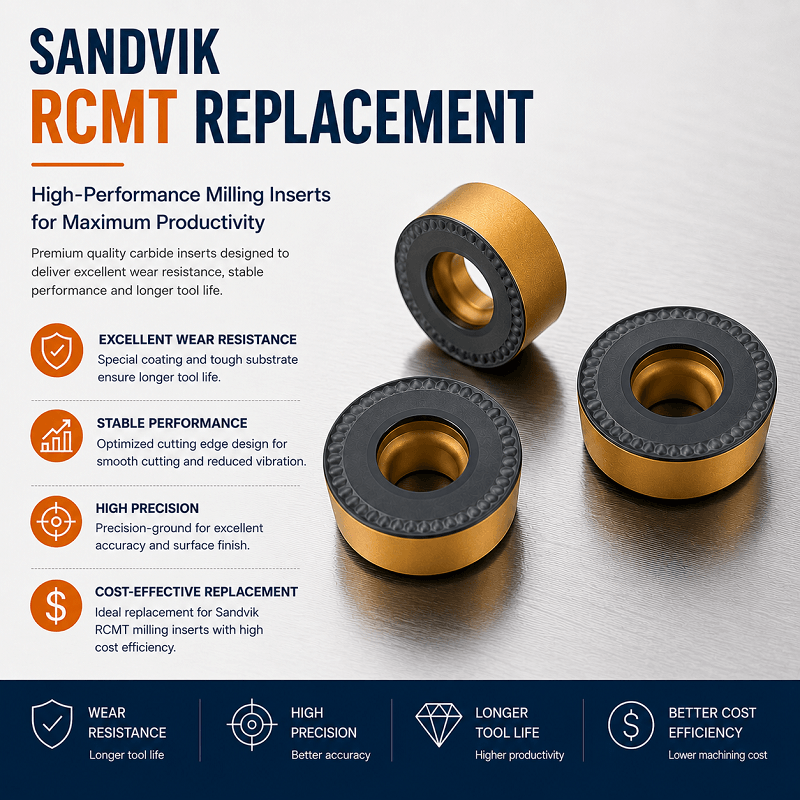
Introduction
Sandvik RCMT inserts are widely used in CNC milling applications where high edge strength, smooth cutting action, and excellent reliability are required. Their round geometry makes them particularly suitable for heavy-duty milling, profile milling, copy milling, and machining complex surfaces.
For manufacturers, distributors, and machine shops seeking to reduce tooling costs or diversify their supply chain, high-quality compatible RCMT inserts offer a practical alternative. When the insert dimensions, clamping system, carbide grade, and coating are correctly matched, compatible inserts can deliver stable machining performance across a wide range of milling applications.
This guide explains how to choose a compatible Sandvik RCMT replacement, what specifications should be verified, and how to select the most suitable insert for different workpiece materials.
What Is an RCMT Insert?
RCMT is an ISO-designated round indexable carbide insert primarily designed for CNC milling operations.
Unlike square or triangular inserts, a round insert has no sharp corners. The cutting forces are distributed over a larger cutting edge, providing excellent strength and resistance to edge chipping. This makes RCMT inserts an excellent choice for heavy cutting conditions and interrupted machining.
Key Features
Round cutting edge with excellent strength
High resistance to edge chipping
Suitable for heavy roughing and profile milling
Excellent performance in interrupted cuts
Multiple indexing positions for longer service life
Available in various carbide grades and coatings
Typical Applications
Compatible RCMT inserts are commonly used in the following milling operations.
Face Milling
Round inserts provide stable cutting performance and efficient material removal during large surface machining.
Profile Milling
The circular cutting edge allows smooth machining of curved surfaces and complex contours.
Copy Milling
RCMT inserts are widely used for copy milling in mold and die manufacturing because the round geometry produces smooth transitions between tool paths.
Heavy Rough Milling
The strong cutting edge withstands high cutting loads and interrupted cutting conditions.
General CNC Milling
RCMT inserts are suitable for general-purpose milling in automotive, energy, heavy equipment, and precision engineering industries.
Common Sandvik RCMT Replacement Sizes
Many RCMT inserts follow standardized dimensions and can be replaced with compatible inserts of the same specification.
| Sandvik Model | Compatible Insert |
|---|---|
| RCMT0602 | RCMT0602 |
| RCMT0803 | RCMT0803 |
| RCMT10T3 | RCMT10T3 |
| RCMT1204 | RCMT1204 |
| RCMT1606 | RCMT1606 |
| RCMT2006 | RCMT2006 |
Before purchasing a replacement, always verify the insert diameter, thickness, center hole, and clamping system used by the milling cutter.
Key Specifications to Match
When selecting a compatible RCMT insert, ensure the following specifications match the original insert.
| Specification | Recommendation |
|---|---|
| Insert Style | RCMT |
| Insert Diameter | Same as original |
| Insert Thickness | Same specification |
| Center Hole | Compatible with cutter body |
| Clamping System | Match the original cutter |
| Carbide Grade | Suitable for workpiece material |
| Coating | Comparable CVD or PVD coating |
Proper compatibility helps maintain machining accuracy, tool life, and operational safety.
Choosing the Right Carbide Grade
Insert geometry is only one factor in achieving good machining performance. Selecting the appropriate carbide grade is equally important.
| Workpiece Material | Recommended Grade |
|---|---|
| Carbon Steel | ISO P25–P35 CVD-coated |
| Alloy Steel | ISO P20–P35 |
| Stainless Steel | ISO M20–M30 PVD-coated |
| Cast Iron | ISO K20–K30 |
| Heat-Resistant Alloys | ISO S-grade |
| Titanium Alloys | Fine-grain PVD-coated carbide |
The correct grade improves wear resistance, cutting stability, and overall productivity.
Advantages of Compatible RCMT Inserts
Lower Tooling Costs
Compatible inserts provide an economical solution for reducing tooling expenses while maintaining consistent machining performance.
Reliable Compatibility
ISO-standard dimensions allow compatible inserts to fit many existing milling cutter bodies without modification.
Excellent Edge Strength
The round cutting edge distributes cutting loads evenly, reducing the risk of edge chipping during demanding machining operations.
Flexible Supply Chain
Alternative suppliers help reduce procurement risks and improve production continuity.
Broad Material Coverage
Suitable carbide grades are available for machining steel, stainless steel, cast iron, titanium alloys, and other engineering materials.
How to Select the Best Replacement
Before selecting an RCMT replacement, consider the following factors:
Milling cutter model
Insert size and mounting system
Workpiece material
Cutting speed
Feed per tooth
Axial depth of cut
Radial width of cut
Coolant application
Surface finish requirements
Selecting the correct combination of insert geometry, carbide grade, and coating helps maximize machining efficiency and tool life.
Industries That Commonly Use RCMT Inserts
Compatible RCMT inserts are widely used in:
Automotive manufacturing
Aerospace machining
Mold and die production
Heavy equipment manufacturing
Railway industry
Energy equipment
General precision machining
Metal fabrication
Frequently Asked Questions
Can a compatible RCMT insert replace a Sandvik RCMT insert?
In many applications, yes. If the insert has the same RCMT designation, dimensions, center hole, and mounting system, it can generally be used in the same milling cutter. Compatibility should always be confirmed before production.
Why choose a round milling insert?
Round inserts provide greater edge strength than inserts with sharp corners. They are particularly suitable for heavy-duty milling, interrupted cuts, and profile machining where durability is important.
Which coating is better for RCMT inserts?
CVD-coated grades are commonly used for steel and cast iron because of their excellent wear resistance. PVD-coated grades are often preferred for stainless steel, titanium alloys, and applications requiring a sharper cutting edge.
Are compatible RCMT inserts suitable for high-speed milling?
Yes. When combined with the correct carbide grade and appropriate cutting parameters, compatible RCMT inserts can achieve stable performance in both conventional and high-speed CNC milling operations.
Conclusion
Sandvik RCMT inserts are widely recognized for their durability and excellent performance in CNC milling applications. Choosing a high-quality compatible RCMT replacement allows manufacturers to maintain machining efficiency while reducing tooling costs and improving supply flexibility.
To achieve the best results, verify insert dimensions, cutter compatibility, carbide grade, and coating before replacement. A properly selected compatible RCMT insert can deliver reliable performance, long tool life, and consistent machining quality in face milling, profile milling, copy milling, and other demanding milling operations.