Overcoming Difficult-to-Machine Materials: How to Solve Rapid Tool Wear in Titanium Alloy Turning
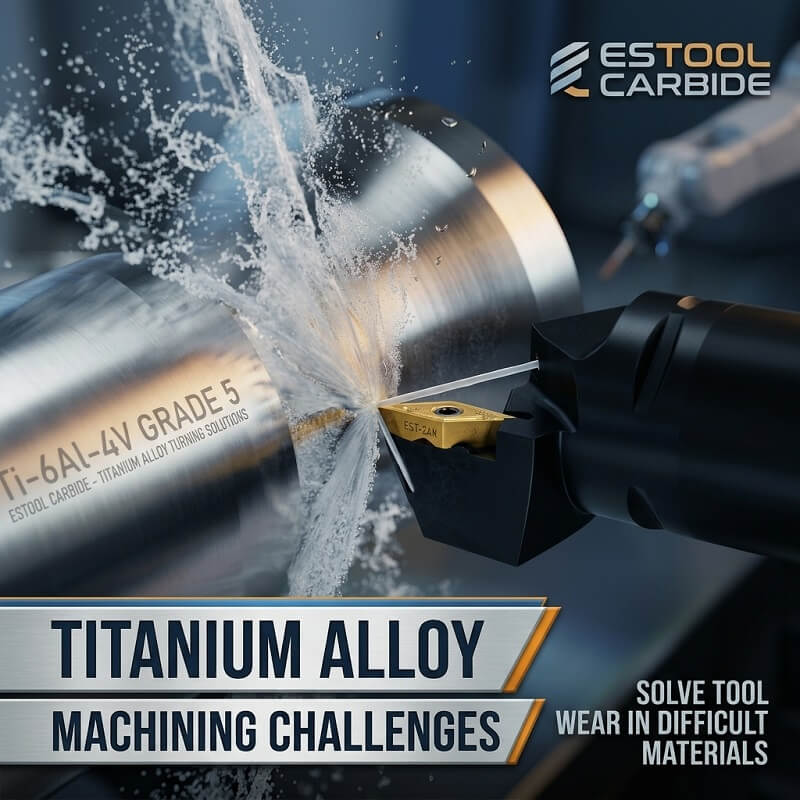
Introduction: Why Is Titanium Turning So Challenging?
Titanium alloys, particularly Ti-6Al-4V (Grade 5), are widely used in aerospace, medical devices, and high-performance engineering because of their excellent strength-to-weight ratio, corrosion resistance, and mechanical performance.
However, these same properties make titanium alloys challenging to machine. During CNC turning, low thermal conductivity concentrates heat around the cutting zone, while titanium's chemical affinity for cutting tool materials can contribute to adhesion, material transfer, and premature cutting-edge damage.
For manufacturers, rapid carbide insert wear can lead to frequent tool changes, inconsistent surface finish, increased production costs, and unplanned machine downtime.
How can you extend carbide insert life when turning titanium alloys?
The key is to optimize the entire machining process, including carbide substrate selection, insert geometry, cutting parameters, coolant delivery, and machine stability.
In this guide, Estool Carbide explains the major causes of rapid tool wear in titanium turning and outlines practical methods for improving tool life and machining consistency.
1. Why Do Titanium Alloys Cause Rapid Carbide Insert Wear?
Understanding the wear mechanism is the first step toward selecting the right titanium turning insert.
1.1 Low Thermal Conductivity and Heat Concentration
Titanium alloys conduct heat less effectively than many conventional machining materials. As a result, heat generated during cutting can remain concentrated near the tool-chip interface and cutting edge.
Excessive cutting temperatures can accelerate wear, promote material adhesion, and contribute to cutting-edge deformation or failure.
Recommended solutions:
- Start with a conservative cutting speed based on the insert manufacturer's recommendations.
- Use a carbide grade designed for the thermal and mechanical demands of titanium machining.
- Maintain effective coolant delivery when the selected machining process requires it.
- Avoid prolonged rubbing or unnecessary tool dwell.
1.2 Chemical Affinity and Adhesion
At elevated temperatures, titanium can adhere strongly to the cutting edge. This may produce built-up material on the rake face or cutting edge.
When the adhered material separates, it can damage the cutting edge and cause unstable tool life.
Recommended solutions:
- Evaluate uncoated and appropriately coated carbide grades for the specific operation.
- Select a sharp cutting edge with suitable rake geometry.
- Maintain stable cutting conditions to minimize repeated adhesion and detachment.
- Inspect the insert regularly for material buildup and edge damage.
1.3 Workpiece Springback and Notch Wear
Titanium alloys have a relatively low elastic modulus compared with steel. During cutting, the workpiece may elastically recover against the tool flank, increasing contact and friction.
Notch wear can also develop near the depth-of-cut line, particularly when the surface condition, material variation, and cutting-edge loading combine to concentrate wear in this region.
Recommended solutions:
- Improve workpiece clamping and reduce unnecessary tool overhang.
- Use a suitable clearance angle and cutting-edge geometry.
- Select a stable depth of cut that avoids repeatedly loading a damaged section of the edge.
- Investigate surface scale, forging conditions, and other material variations when notch wear occurs consistently.
1.4 Vibration and Cutting-Edge Chipping
Vibration, interrupted cutting, poor clamping, and excessive cutting forces can cause carbide inserts to chip or fracture.
A grade optimized for wear resistance may not provide enough toughness for an unstable machining setup.
Recommended solutions:
- Improve machine and workpiece rigidity.
- Reduce toolholder overhang wherever possible.
- Match insert toughness and edge preparation to the cutting conditions.
- Adjust cutting parameters systematically instead of changing several variables simultaneously.
2. Select the Right Carbide Insert for Titanium Turning
Selecting the right insert requires balancing wear resistance, toughness, edge sharpness, and chemical compatibility.
Titanium alloys are generally classified within ISO material group S. However, the ideal grade and geometry depend on the specific alloy, operation, cutting speed, and coolant conditions.
2.1 Choose the Appropriate Carbide Substrate
Fine-grain and ultra-fine-grain cemented carbide grades are worth evaluating for titanium turning because they can support sharp cutting edges and suitable wear resistance.
The binder content, grain structure, hardness, and toughness must be considered together.
- Finishing operations: Prioritize edge sharpness, dimensional consistency, and surface-finish performance.
- Roughing operations: Balance wear resistance with sufficient toughness to withstand higher cutting loads.
- Interrupted cutting: Give particular attention to edge strength, workholding stability, and resistance to chipping.
Higher cobalt content does not automatically produce better performance. Although additional binder can improve toughness, the resulting hardness and wear resistance also depend on the overall carbide formulation.
Choose a grade according to the actual machining conditions rather than one material property alone.
2.2 Coated vs. Uncoated Carbide Inserts
Neither coated nor uncoated carbide inserts are universally superior for titanium machining.
Uncoated carbide can be effective in applications where a very sharp edge, low adhesion tendency, and favorable surface interaction are important. Certain coated carbide grades may also perform well when their coating system, substrate, and edge preparation are specifically suited to the operation.
PVD coatings such as TiAlN- or AlTiN-based systems should be evaluated based on the insert manufacturer's application data and actual cutting results. Their effectiveness should not be assumed solely from hardness or oxidation-resistance specifications.
| Selection factor | Uncoated carbide | PVD-coated carbide |
|---|---|---|
| Cutting-edge sharpness | Can support a very sharp edge | Depends on coating and edge preparation |
| Adhesion behavior | May perform well in suitable conditions | Depends on coating chemistry and cutting conditions |
| Thermal and wear performance | Depends on substrate and operating conditions | May provide benefits in suitable applications |
| Recommended approach | Evaluate for precision and finishing work | Evaluate for the intended grade and operation |
Practical recommendation: Conduct a controlled comparison using the same workpiece material, cutting parameters, coolant conditions, and tool-life criteria. Measure performance rather than assuming a coating will always extend tool life.
2.3 Choose the Correct Insert Shape and Chipbreaker
Insert geometry affects cutting forces, chip formation, surface finish, and cutting-edge strength.
When selecting a titanium turning insert, consider:
- Rake angle: A suitable positive rake can reduce cutting forces and promote efficient shearing.
- Nose radius: Select a radius that balances surface-finish requirements and cutting stability.
- Edge preparation: Avoid unnecessarily heavy edge preparation when a sharp cutting edge is required, but maintain sufficient strength for the operation.
- Chipbreaker: Choose a chipbreaker that matches the intended feed rate and depth of cut.
A positive-rake geometry is often a useful starting point for titanium turning. However, the optimal geometry must account for the operation, workpiece rigidity, and risk of edge chipping.
3. Optimize Cutting Parameters for Ti-6Al-4V Turning
Cutting parameters have a direct influence on tool life, productivity, and surface quality.
The following ranges are initial trial values for evaluation, not universal settings or guaranteed recommendations. Confirm the correct operating window with the insert manufacturer's technical data and the specific machining setup.
3.1 Cutting Speed
For initial trials involving carbide inserts and Ti-6Al-4V, a cutting-speed range of approximately 40–60 m/min may be considered, depending on the grade, insert geometry, operation, and coolant strategy.
Some applications may require lower or higher speeds.
If rapid flank wear or thermal damage occurs, test a reduction in cutting speed while keeping the other major variables constant.
Do not assume that the lowest possible speed will always produce the longest tool life. Excessively conservative settings can affect productivity and may contribute to rubbing or unstable chip formation in certain conditions.
3.2 Feed Rate
Feed rate influences chip thickness, cutting forces, surface finish, and material removal rate.
For an initial rough-turning trial, approximately 0.10–0.25 mm/rev may be evaluated when compatible with the insert geometry and manufacturer's recommendations.
The appropriate value for finishing may be substantially lower.
Avoid reducing feed automatically whenever tool wear appears. An unsuitable feed can cause the cutting edge to rub rather than cut efficiently, while excessive feed can increase cutting loads and the risk of chipping.
3.3 Depth of Cut
Depth of cut should be selected according to the operation, insert geometry, workpiece rigidity, and material condition.
For roughing, the cut should provide stable engagement and efficient material removal without overloading the cutting edge.
For finishing, use a depth of cut that removes the required material consistently and avoids excessive rubbing.
When notch wear occurs, investigate whether the depth-of-cut line repeatedly contacts a damaged or unfavorable region of the workpiece. Adjusting the depth of cut may help, but the solution depends on the specific wear mechanism.
3.4 Example Starting Conditions
| Parameter | Rough turning | Finish turning |
|---|---|---|
| Cutting speed | Test around 40–60 m/min | Establish a suitable range from grade data |
| Feed rate | Test around 0.10–0.25 mm/rev | Select according to surface-finish requirements |
| Depth of cut | Select for stable material removal | Use a controlled finishing allowance |
| Main objective | Productivity and edge stability | Surface quality and dimensional consistency |
These values are intended for preliminary evaluation of Ti-6Al-4V with carbide inserts. They should not replace the insert supplier's recommendations or a machining trial.
For production use, document the actual cutting conditions and adjust one major variable at a time wherever practical.
4. Improve Coolant Delivery and Chip Control
Coolant can help control temperature, improve chip evacuation, and stabilize the cutting process. Its effectiveness depends on how it is delivered and on the selected insert and operation.
4.1 Evaluate High-Pressure Coolant
High-pressure coolant may improve chip control and cutting performance in suitable titanium turning applications.
However, a higher pressure does not automatically guarantee longer tool life. Nozzle position, flow rate, coolant formulation, machine capability, and insert geometry all influence the result.
When evaluating high-pressure coolant:
- Confirm that the tooling system is designed for the intended pressure.
- Direct the coolant toward the cutting zone according to the tool manufacturer's guidance.
- Check whether chip evacuation improves.
- Compare tool wear and production stability against the existing coolant setup.
4.2 Maintain Consistent Coolant Delivery
Inspect coolant nozzles, filters, pumps, and flow conditions regularly.
Where continuous coolant application is required, avoid unintended interruptions that may destabilize the cutting process.
Follow the insert manufacturer's guidance for coolant use, particularly when machining interrupted surfaces or using specialized carbide grades.
4.3 Improve Chip Evacuation
Titanium can produce long or difficult-to-control chips depending on the alloy, geometry, and cutting conditions.
Poor chip control can damage the finished surface, interrupt automated production, and create safety hazards.
Choose a suitable chipbreaker and adjust coolant direction to prevent chips from accumulating around the cutting edge.
Dry machining should not be described as universally impossible, but coolant-assisted turning is often an important strategy for managing heat and chips. The appropriate method depends on the tooling system, operation, and manufacturer's recommendations.
5. Troubleshoot Common Titanium Turning Insert Wear Problems
Identifying the actual wear pattern helps prevent unnecessary insert changes and ineffective parameter adjustments.
| Observed problem | Possible cause | Recommended action |
|---|---|---|
| Rapid flank wear | Excessive cutting speed, unsuitable grade, abrasive wear | Review cutting speed, grade, and wear progression |
| Built-up material | Adhesion, unsuitable geometry, unstable conditions | Evaluate edge sharpness, grade, and cutting conditions |
| Cutting-edge chipping | Vibration, excessive loading, unsuitable edge strength | Improve rigidity and review edge preparation |
| Notch wear | Localized contact, material surface condition, repeated loading | Review depth of cut and inspect the workpiece |
| Crater wear | High cutting-zone temperature and unsuitable tool material | Reassess grade suitability and cutting conditions |
| Poor surface finish | Worn insert, vibration, unsuitable feed or nose radius | Inspect the edge and optimize the setup |
| Inconsistent tool life | Variable material batches, clamping, coolant, or cutting conditions | Standardize the process and investigate variation |
These wear mechanisms can occur simultaneously. For example, adhesion may contribute to edge chipping, while vibration can accelerate damage to an already worn cutting edge.
Inspect worn inserts under magnification whenever possible. Combine the inspection results with cutting records before deciding whether to change the grade, geometry, or parameters.
6. A Systematic Process for Extending Tool Life
For manufacturers experiencing frequent insert replacement, a structured troubleshooting process is more effective than changing tooling without measuring the results.
Step 1: Confirm the Workpiece Material
Identify the exact titanium alloy, material condition, and relevant manufacturing history. Ti-6Al-4V and commercially pure titanium should not automatically be treated as identical machining applications.
Step 2: Identify the Wear Mechanism
Inspect the insert for flank wear, adhesion, notch wear, chipping, and other visible damage.
Record photographs and compare worn inserts from different production runs.
Step 3: Check the Machine and Tooling Setup
Review workpiece clamping, toolholder rigidity, tool overhang, runout, coolant delivery, and chip evacuation.
Mechanical instability can shorten tool life even when the insert grade is appropriate.
Step 4: Establish a Baseline
Record the existing insert model, grade, cutting speed, feed rate, depth of cut, coolant conditions, and number of components produced per cutting edge.
This baseline makes it possible to evaluate improvements objectively.
Step 5: Run Controlled Trials
Change one major variable at a time whenever practical. Possible trials include:
- Reducing cutting speed.
- Testing a different carbide grade.
- Comparing coated and uncoated inserts.
- Adjusting chipbreaker geometry.
- Improving coolant direction or delivery.
Keep other conditions consistent so that the cause of any improvement can be identified.
Step 6: Calculate the Cost per Component
The lowest-priced insert is not necessarily the most economical choice.
Consider insert cost, usable cutting edges, tool life, machine downtime, tool-change labor, rejected components, and overall production throughput.
Step 7: Standardize the Best Result
Document the successful insert specification and cutting conditions. Continue monitoring performance when material batches, machine setups, or component geometries change.
7. How to Evaluate Whether a New Insert Is Better
A carbide insert should be assessed using measurable production outcomes rather than promotional claims alone.
Useful indicators include:
- Parts per cutting edge: How many acceptable components can be produced before indexing or replacement?
- Tool life: How long does the insert perform within the required wear limits?
- Surface finish: Does the insert consistently meet the required surface roughness?
- Dimensional accuracy: Can the process maintain the required tolerances?
- Production stability: Are unexpected tool changes and interruptions reduced?
- Cost per component: Does the new insert reduce the total cost of producing an acceptable part?
When comparing two inserts, use the same workpiece material, machine, cutting parameters, and evaluation criteria wherever possible.
A documented trial provides a more reliable basis for purchasing decisions than comparing insert prices or relying on tool-life claims without supporting data.
8. Frequently Asked Questions About Titanium Turning Inserts
Which carbide inserts are suitable for Ti-6Al-4V turning?
Suitable inserts depend on whether the operation is roughing, semi-finishing, or finishing. Fine-grain carbide grades with appropriate edge geometry are useful candidates, but the final selection should be based on the manufacturer's recommendations and actual machining conditions.
Are coated or uncoated carbide inserts better for titanium?
Neither option is universally better. Uncoated inserts may perform well in applications requiring a very sharp edge, while certain coated grades may be suitable for other operating conditions. Compare their performance using controlled machining trials.
What cutting speed should I use for titanium turning?
A preliminary trial around 40–60 m/min may be considered for carbide turning of Ti-6Al-4V, depending on the tooling system and operation. Always confirm the applicable range with the insert manufacturer's technical data.
How can I reduce notch wear when turning titanium?
Inspect the depth-of-cut line, workpiece surface condition, and cutting-edge geometry. Review the depth of cut, clamping rigidity, and wear pattern before making adjustments.
Does high-pressure coolant extend carbide insert life?
High-pressure coolant may improve chip control and tool performance in suitable applications. Its effectiveness depends on the coolant system, insert design, workpiece material, and cutting conditions.
How can I reduce the total cost of titanium machining?
Focus on cost per acceptable component. Optimize insert selection, control wear, reduce unexpected tool changes, maintain surface quality, and evaluate production throughput rather than choosing inserts solely by purchase price.
Conclusion: Reduce Tool Wear with the Right Titanium Turning Strategy
Rapid carbide insert wear in titanium turning is influenced by several interacting factors, including heat concentration, adhesion, cutting-edge geometry, cutting parameters, coolant delivery, and machine stability.
The most effective solution begins with identifying the actual wear mechanism and selecting an insert suited to the specific titanium alloy and operation.
By combining appropriate carbide grades, stable cutting conditions, effective chip control, and systematic tool-life evaluation, manufacturers can improve machining consistency and make better-informed tooling decisions.
Need help selecting carbide turning inserts for titanium alloys?
Estool Carbide provides carbide tooling solutions for a range of CNC machining applications. Our team can review your current insert specification and machining conditions to help identify suitable replacement options.
To support an effective recommendation, please provide:
- Workpiece material: Ti-6Al-4V, commercially pure titanium, or another alloy.
- Current insert model: Insert shape, size, grade, and chipbreaker, if known.
- Cutting conditions: Cutting speed, feed rate, depth of cut, and coolant method.
- Current problem: Flank wear, notch wear, chipping, poor surface finish, or short tool life.
- Production target: Required tool life, surface finish, or cost-per-part improvement.
Explore our carbide turning inserts: https://www.estoolcarbide.com/pro_cat/turning-inserts/index.html
Send us your application details to discuss suitable insert options for your titanium turning operation.